
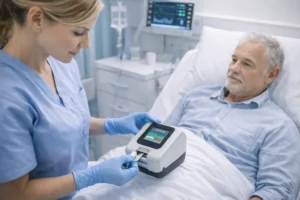
 Modern healthcare relies heavily on the speed and accuracy of diagnostic information to save lives and manage chronic conditions effectively. Point-of-care testing represents a transformative shift in this field, bringing the laboratory directly to the patient. By providing immediate results, healthcare providers can make informed decisions without the traditional delays associated with off-site processing. Whether in a hospital, a rural clinic, or a patient’s home, POCT ensures that the gap between diagnosis and treatment is minimized, ultimately fostering a more responsive and patient-centered medical environment.
What Is Point-of-Care Testing (POCT)?
Point-of-care testing is defined as medical diagnostic testing performed at or near the site of patient care. Unlike traditional methods where samples are collected and sent to a centralized laboratory, rapid diagnostic testing occurs exactly where the patient is located. This “bedside testing” approach allows for the immediate analysis of blood, urine, or saliva samples, providing actionable data within minutes. The core philosophy of POCT is to bring the test to the patient rather than moving the patient or their specimen to a distant facility.
The primary difference between point-of-care diagnostics and centralized laboratory testing lies in the infrastructure and turnaround time. Centralized labs are equipped for high-volume, complex automated testing but often require hours or days for results due to logistics and batch processing. In contrast, medical POCT devices are portable, user-friendly, and designed for single-use or small-batch analysis. While centralized labs remain essential for complex assays, bedside testing fills a critical need for clinical immediacy. By eliminating the transport of specimens and the administrative lag of lab reporting, healthcare providers can implement life-saving interventions immediately. This decentralized model is particularly vital in emergency rooms, intensive care units, and remote geographical areas where access to a full-scale laboratory is limited or nonexistent.
Importance of POCT in Modern Healthcare
The importance of point-of-care testing in modern healthcare cannot be overstated, as it directly impacts the efficiency of clinical workflows and patient safety. The most significant benefit is the drastic reduction in turnaround time for critical test results. In acute scenarios such as cardiac arrest or sepsis, every second counts. By using rapid diagnostic testing, clinicians can identify biomarkers or metabolic imbalances instantly, allowing for “real-time” adjustments to treatment plans. This speed leads to faster diagnosis and clinical decision-making, which is the cornerstone of effective emergency medicine and critical care.
Beyond emergency use, POCT enhances improved patient outcomes and workflow efficiency across various medical settings. In outpatient clinics, a physician can perform a test and discuss the results with the patient during a single visit, eliminating the need for follow-up appointments and reducing patient anxiety. This streamlined process also reduces the burden on hospital staff by simplifying the sample tracking and data entry stages. Furthermore, by identifying infectious diseases or deteriorating conditions earlier, point-of-care diagnostics helps in reducing the overall length of hospital stays and minimizing the risk of complications. As healthcare systems globally face increasing pressure to provide high-quality care with limited resources, the integration of medical POCT serves as a vital tool for optimizing resource allocation and ensuring that patients receive the right care at the right time.
Common Types of POCT Applications
The versatility of point-of-care testing allows it to be utilized across a wide range of medical specialties, from routine monitoring to complex emergency diagnostics. By categorizing these applications, we can better understand how decentralized testing supports different aspects of patient health.
Blood and Biochemical Testing
One of the most frequent applications of POCT involves monitoring glucose, electrolytes, and blood gas levels. This is especially critical for diabetic patients who require frequent glucose checks to manage insulin dosages. In hospital settings, blood gas analysis provides immediate insights into a patient’s respiratory and metabolic status. These tests play a pivotal role in emergency and critical care settings, where rapid shifts in blood chemistry must be detected and corrected to prevent organ failure.
Infectious Disease Testing
Rapid diagnostic testing has revolutionized the management of infectious diseases by providing quick results for viral and bacterial infections. Tests for influenza, strep throat, and more recently, respiratory viruses, allow for immediate isolation and treatment. This rapid turnaround is a major contribution to outbreak control and infection management within communities and healthcare facilities. By identifying pathogens at the point of contact, medical professionals can prevent the further spread of disease and ensure that antibiotics are prescribed only when necessary.
Cardiac and Chronic Disease Monitoring
Point-of-care diagnostics is extensively used in cardiac markers and chronic condition management. For patients presenting with chest pain, testing for troponin levels at the bedside can quickly confirm or rule out a myocardial infarction. Additionally, for those with chronic illnesses like heart failure or kidney disease, medical POCT supports ongoing patient monitoring. This proactive approach enables patients and providers to track disease progression and adjust medications accurately, reducing the likelihood of acute exacerbations and hospital readmissions.
Advantages and Limitations of POCT
The adoption of point-of-care testing offers numerous benefits, primarily centered around speed, accessibility, and patient convenience. By providing results in a matter of minutes, it empowers clinicians to initiate treatment immediately, which is often life-saving. For patients in remote or underserved areas, POCT provides access to essential diagnostics that would otherwise require long-distance travel. Furthermore, the convenience of receiving a diagnosis and a prescription in one visit significantly improves the patient experience and adherence to treatment protocols.
However, there are limitations related to accuracy, quality control, and cost that must be addressed. While technology has improved, some rapid diagnostic testing kits may have lower sensitivity or specificity compared to gold-standard laboratory equipment. Quality control can be more challenging to maintain across dozens of decentralized devices compared to a single lab environment. Additionally, the cost per test for point-of-care diagnostics is often higher than the cost of high-volume testing in a central lab. Therefore, the importance of appropriate test selection is paramount; healthcare facilities must weigh the clinical need for speed against the economic and technical requirements of the technology to ensure the best possible care.
Quality Control and Regulatory Requirements
To maintain the integrity of medical POCT, ensuring accuracy and reliability of results is a top priority. Unlike a centralized lab managed by specialized pathologists, point-of-care devices are often operated by nurses, paramedics, or even the patients themselves. This necessitates rigorous training and competency of healthcare personnel to avoid pre-analytical and analytical errors. Every individual using these devices must be trained not only on how to perform the test but also on how to interpret the results and maintain the equipment properly.
Compliance with regulatory and accreditation standards is essential for any facility implementing POCT. In many regions, this involves following strict guidelines for calibration, proficiency testing, and documentation. Regular audits and quality checks ensure that the devices are functioning within specified parameters. By adhering to these standards, healthcare providers can guarantee that the data generated at the bedside is as trustworthy as that from a professional laboratory. Establishing a robust quality management system is the only way to mitigate the risks associated with decentralized testing and to ensure that rapid diagnostic testing remains a safe and effective tool for clinical intervention.
POCT and Healthcare Logistics
The success of a decentralized testing program depends heavily on the efficient storage and distribution of POCT devices and consumables. Because these tests are distributed throughout various departments or even across different geographical sites, managing the inventory of test strips, reagents, and cartridges is a complex task. Supply chain planning for decentralized testing environments must account for the specific shelf lives and usage rates of various tests to prevent waste or stockouts.
Temperature and handling considerations are particularly critical for medical POCT. Many diagnostic reagents are sensitive to heat or humidity and require climate-controlled storage to maintain their efficacy. If a test kit is compromised by poor environmental conditions, it can lead to inaccurate results and jeopardize patient safety. Therefore, logistics providers must ensure a “cold chain” or specific environmental monitoring during transport and storage. Proper handling protocols ensure that when a clinician reaches for a rapid diagnostic testing kit in a moment of crisis, the device performs exactly as intended, providing reliable data for immediate care.
Role of POCT in Public Health and Emergency Response
In the face of global health crises, point-of-care testing has emerged as a frontline defense mechanism. Rapid diagnostics during outbreaks and emergencies allow public health officials to screen large populations quickly, identifying and isolating infected individuals to slow the spread of disease. During natural disasters or mass casualty events, where traditional infrastructure may be destroyed, portable point-of-care diagnostics enable medics to perform essential triage and early intervention on-site, directing resources to those who need them most urgently.
Furthermore, POCT enhances healthcare system responsiveness by providing data that can be used for real-time surveillance. When results are aggregated from various testing sites, health authorities can identify emerging clusters of illness and deploy targeted interventions. The ability to perform rapid diagnostic testing in non-traditional settings—such as airports, schools, or mobile clinics—dramatically expands the reach of the healthcare system. By decentralizing the diagnostic process, society becomes better equipped to handle both localized emergencies and large-scale public health threats, ensuring that diagnostic capabilities are always available where the impact is greatest.
Future Trends in Point-of-Care Testing
The landscape of point-of-care testing is rapidly evolving, driven by advances in portable and digital diagnostic technologies. We are seeing the development of “lab-on-a-chip” devices that can perform multiple complex assays from a single drop of blood. Additionally, the miniaturization of molecular diagnostics is making PCR-quality testing available at the bedside. These innovations are making point-of-care diagnostics more accurate, faster, and more affordable, further blurring the lines between the capability of a bedside device and a full-scale clinical laboratory.
Another significant trend is the integration with electronic health records (EHR). Modern medical POCT devices are increasingly equipped with wireless connectivity, allowing results to be uploaded automatically to a patient’s digital file. This ensures that all members of the care team have immediate access to the latest data and reduces the risk of manual transcription errors. As artificial intelligence and machine learning become more integrated into these platforms, we can expect rapid diagnostic testing to not only provide raw data but also offer predictive insights and decision support. The future of healthcare is one where diagnostics are ubiquitous, invisible, and instantaneous, powered by the continued growth of the POCT sector.