
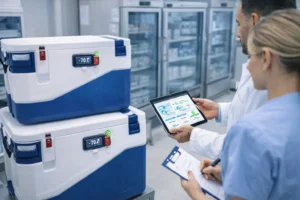
 The vaccine cold chain is a specialized, temperature-controlled supply chain designed to ensure that life-saving immunizations remain potent from the point of manufacture to the moment they are administered to a patient. Unlike standard logistics, vaccine storage and transport require a seamless network of refrigerators, freezers, and thermal packaging that prevents any exposure to heat or excessive cold. This system is a “chain” because a single break in temperature control at any stage—whether during international transit, local storage, or the final journey to a remote clinic—can irreversibly damage the biological integrity of the product.
While a general cold chain might handle perishable foods or various pharmaceuticals, a vaccine-specific cold chain is subject to much more rigorous standards and narrower temperature margins. Vaccines are delicate biological substances; some are sensitive to freezing, while others degrade rapidly if exposed to room temperature. This specialized infrastructure involves dedicated medical-grade equipment and precise temperature controlled vaccine logistics to manage these sensitivities. Every individual involved, from laboratory technicians to logistics providers and healthcare workers, plays a critical role in maintaining this thermal environment. By ensuring that vaccines are kept within their required ranges at every step of the immunization cold chain, global health systems can guarantee that every dose delivered is capable of providing the intended protection against infectious diseases.
What Is the Vaccine Cold Chain?
The vaccine cold chain is defined as the entire system of people, equipment, and procedures used to maintain vaccines within a specific temperature range from the production line to the patient. This process begins the moment a vaccine is manufactured and continues through international transport, national depots, regional hubs, and finally to the healthcare facility where it is used. At each transition point, specialized cooling technology and rigorous monitoring protocols are employed to ensure that the environment remains stable. Vaccine cold chain logistics encompass not just the hardware—like ultra-low temperature freezers and refrigerated trucks—but also the specialized training of personnel who must handle these sensitive products with precision.
The core clear definition of the vaccine cold chain centers on the preservation of biological efficacy through a continuous explanation of temperature-controlled handling from manufacturer to patient. While food logistics focus on preventing spoilage, the difference between general cold chain and vaccine-specific cold chain lies in the stakes of failure; a compromised vaccine does not just lose value, it fails to protect a human life. By integrating advanced vaccine storage and transport solutions, the system creates a resilient pathway for global health security. Every link in this chain must be validated to ensure that no external environmental factor interferes with the vaccine’s delicate chemical balance.
Importance of the Vaccine Cold Chain in Public Health
The primary goal of a robust cold chain is protecting vaccine potency and effectiveness. Most vaccines contain active biological components that are highly susceptible to thermal degradation. If a vaccine is exposed to temperatures outside its validated range, its molecular structure can change, rendering it useless. Because this damage is often invisible—a vial may look perfectly normal even if it has lost all potency—the only way to ensure safety is through constant vigilance. Without a functional vaccine cold chain, the entire scientific effort of vaccine development would be undermined at the final mile of delivery.
Furthermore, preventing vaccine spoilage and wastage is a critical economic and ethical necessity. Vaccines are expensive and often in short supply during public health crises; losing doses to equipment failure or logistical errors is a significant setback for global health equity. Beyond the financial loss, ensuring successful immunization outcomes is the ultimate metric of success. When a child or adult receives a vaccine that has been properly managed through immunization cold chain protocols, the community moves one step closer to herd immunity. Conversely, a failure in temperature controlled vaccine logistics can lead to outbreaks of preventable diseases, diminishing public trust in healthcare systems and leaving populations vulnerable to infection.
Temperature Requirements for Vaccines
Refrigerated Vaccine Storage
Most routine immunizations require refrigerated vaccine storage, typically maintained between 2°C and 8°C (36°F to 46°F). This narrow window is the standard temperature ranges for most vaccines, including those for polio, diphtheria, and tetanus. Maintaining this specific environment is challenging because even a slight drop below freezing can destroy freeze-sensitive vaccines just as quickly as heat can. Consequently, monitoring and stability considerations are paramount; facilities must use continuous temperature data loggers rather than simple thermometers to track fluctuations. Effective vaccine cold chain logistics at this level involve the use of solar-powered or electric refrigerators equipped with backup power to prevent excursions during outages. By strictly adhering to these vaccine storage and transport protocols, healthcare providers ensure that the vaccine remains “live” and ready to trigger the necessary immune response in the recipient.
Frozen and Ultra-Cold Chain Vaccines
In recent years, the rise of mRNA technology and certain viral vector vaccines has introduced special requirements for certain vaccines, necessitating frozen or even ultra-cold storage. These products often require temperatures as low as -70°C, creating a significant demand for specialized infrastructure and equipment needs, such as ultra-low temperature (ULT) freezers and dry ice shipping containers. Managing these requirements within the immunization cold chain is significantly more complex than standard refrigeration, as it requires specialized PPE for handlers and faster transit times. Implementing temperature controlled vaccine logistics for ultra-cold products involves high-tech vacuum-insulated panels and real-time GPS-linked thermal sensors. This tier of the vaccine cold chain highlights the need for constant innovation to accommodate the next generation of medical breakthroughs while maintaining the highest safety standards across the global distribution network.
Key Components of the Vaccine Cold Chain
The foundation of any successful vaccine cold chain lies in its cold storage facilities and equipment. This includes walk-in cold rooms at national levels, specialized medical refrigerators at clinics, and portable vaccine carriers for outreach missions. These tools are engineered specifically to hold temperatures steady even in high-ambient environments. Alongside storage, refrigerated transportation and packaging form the mobile link of the chain. Specialized vehicles and passive cooling containers (using ice packs or phase-change materials) ensure that the vaccine storage and transport process remains uninterrupted during the physical movement between various supply chain nodes.
Equally important are the temperature monitoring and documentation systems that provide proof of integrity. Modern vaccine cold chain logistics rely on digital sensors that record temperature data at every minute of the journey. This data is essential for the immunization cold chain, as it allows logistics managers to identify exactly when and where a “break” might have occurred. Documentation is not just about compliance; it is a vital safety measure that informs healthcare workers whether a batch of vaccines is still safe to use. By combining high-quality hardware with sophisticated temperature controlled vaccine logistics software, organizations can create a transparent and accountable system that protects the public from the risks of compromised medical products.
Cold Chain Breaks and Their Consequences
A “cold chain break” or “temperature excursion” occurs whenever vaccines are exposed to temperatures outside their recommended range. The causes of temperature excursions are varied, ranging from simple human error—such as leaving a refrigerator door ajar—to mechanical failures, power outages, or delays in transport. In many parts of the world, unstable electrical grids are a leading threat to vaccine storage and transport. Regardless of the cause, the impact on vaccine safety and efficacy can be devastating. Heat exposure accelerates the loss of potency, while freezing can cause the formation of microscopic shards in the liquid, potentially causing adverse reactions or rendered the vaccine completely ineffective.
Because the damage is often irreversible, the importance of rapid response and corrective actions cannot be overstated. When a monitoring system alerts a provider to a breach, protocols must be in place to quarantine the affected doses and consult with manufacturers to determine if the “heat stable” limit has been reached. In the context of vaccine cold chain logistics, failure to act quickly results in massive financial waste and, more importantly, a gap in population immunity. Robust immunization cold chain management requires contingency plans, such as backup generators or emergency transport to a secondary site, to mitigate these risks. Maintaining temperature controlled vaccine logistics is a 24/7 commitment to vigilance and proactive problem-solving.
Regulatory Standards and Guidelines for Vaccine Cold Chain
To maintain a high level of safety, the vaccine cold chain must adhere to strict compliance with WHO and national immunization guidelines. These international standards dictate everything from the type of refrigerants allowed in equipment to the specific calibration intervals for thermometers. National health authorities often mandate specific workflows for vaccine storage and transport to ensure that every clinic in the country operates under the same safety umbrella. These regulations are the backbone of the immunization cold chain, providing a clear framework for what constitutes acceptable handling practices and what requires immediate intervention.
Furthermore, rigorous documentation, audits, and validation requirements are standard in the industry. Logistics providers must maintain “Cold Chain Logs” and undergo regular inspections to prove that their temperature controlled vaccine logistics systems are functioning as intended. This level of oversight defines the responsibilities of healthcare and logistics providers, ensuring that no single entity can ignore safety protocols without consequence. In a modern vaccine cold chain logistics environment, digital audit trails have replaced paper logs, allowing for real-time compliance tracking. By following these global and local mandates, the medical community ensures that vaccines remain a reliable tool for public health, backed by a transparent and highly regulated distribution network.
Vaccine Cold Chain in Global Immunization Programs
Implementing a reliable vaccine cold chain is particularly difficult when facing challenges in low-resource and remote settings. In many regions, the lack of a consistent power grid and extreme outdoor temperatures make vaccine storage and transport a Herculean task. To address this, organizations like UNICEF and the WHO have invested in solar-drive-refrigerators and long-range thermal carriers that can maintain temperatures for days without external power. The importance of reliable logistics infrastructure is magnified in these areas, where the “last mile” of delivery might involve motorcycles, boats, or even foot travel to reach isolated communities.
Despite these hurdles, supporting mass vaccination campaigns depends entirely on the resilience of these networks. During large-scale efforts to eradicate diseases like polio, the immunization cold chain must be scaled up rapidly to handle millions of doses simultaneously. This requires a sophisticated level of vaccine cold chain logistics that can coordinate between international donors and local health workers. Successful temperature controlled vaccine logistics in these contexts involve not only technology but also community engagement and meticulous planning. By strengthening the global cold chain, the international community ensures that the benefits of modern medicine are not restricted by geography, making health equity a tangible reality for even the most remote populations.
Role of Logistics and Technology in Vaccine Cold Chain Management
Technology has revolutionized vaccine cold chain logistics through the introduction of real-time monitoring and tracking solutions. Today, logistics managers can use IoT (Internet of Things) devices to track the exact location and internal temperature of a vaccine shipment from across the globe. This level of visibility is essential for risk management and contingency planning, allowing teams to intervene the moment a shipment deviates from its planned route or experiences a temperature spike. In the world of vaccine storage and transport, being proactive rather than reactive can mean the difference between saving a shipment and disposing of it.
Furthermore, ensuring end-to-end cold chain integrity now involves sophisticated data analytics to predict potential failures before they happen. By analyzing historical data on transit times and weather patterns, providers can optimize temperature controlled vaccine logistics to use the most efficient routes and packaging materials. The integration of technology into the immunization cold chain also facilitates better inventory management, reducing the likelihood of vaccines expiring on the shelf. As these digital tools become more accessible, the overall reliability of the global supply chain increases, providing a safer and more efficient pathway for the delivery of essential medicines to every corner of the world.
Future Trends in Vaccine Cold Chain Systems
The future of the vaccine cold chain is being shaped by innovations in cold chain equipment and packaging. We are seeing the development of “smart” containers that can self-regulate their temperature and vaccines that are being engineered to be more heat-stable, potentially reducing the burden on the immunization cold chain. Additionally, sustainable and energy-efficient solutions are becoming a priority. Transitioning to “green” refrigerants and expanding the use of solar-powered cooling systems helps reduce the carbon footprint of vaccine storage and transport while making the system more resilient to energy crises in developing nations.
Finally, strengthening global preparedness for future pandemics is driving a massive overhaul of vaccine cold chain logistics. Lessons learned from the COVID-19 pandemic have highlighted the need for flexible, rapidly deployable temperature controlled vaccine logistics that can handle various temperature profiles at scale. This includes the expansion of local manufacturing hubs to shorten the supply chain and the creation of strategic stockpiles of specialized equipment. As we look forward, the focus remains on building a more robust, intelligent, and equitable cold chain that can respond to any health threat with speed and precision, ensuring that the next generation of vaccines reaches those in need without delay.