
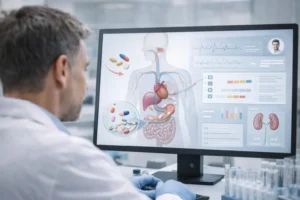
 Pharmacokinetics is a fundamental branch of pharmacology that focuses on the quantitative study of drug movement into, through, and out of the body. To provide a clear definition of pharmacokinetics, it is often described as the study of “what the body does to the drug,” contrasting with pharmacodynamics, which explores “what the drug does to the body.” This field involves a detailed explanation of how the body affects a drug over time, tracking its journey from the moment of administration to its ultimate elimination. Understanding this timeline is crucial for determining how quickly a medicine works and how long its effects will last.
A primary distinction lies in the difference between pharmacokinetics and pharmacodynamics. While pharmacodynamics deals with receptor binding and chemical interactions that lead to a biological effect, pharmacokinetics focuses on the physiological barriers and biochemical changes the drug encounters. By measuring concentrations in the blood or tissues, scientists can map the transition of a substance through various bodily compartments. This data is essential for ensuring that a therapeutic agent reaches its target site at a concentration high enough to be effective but low enough to avoid toxicity. Essentially, it provides the mathematical framework for understanding the lifecycle of a medication within a living organism, allowing clinicians to predict the onset, intensity, and duration of a drug’s pharmacological action based on its chemical properties and the patient’s unique physiology.
Importance of Pharmacokinetics in Drug Therapy
The drug pharmacokinetics profile plays a vital role in determining dosage and dosing intervals for any given treatment. Without this data, clinicians would have no scientific basis for deciding whether a patient should take a pill once a day or every four hours. By analyzing how long a substance remains active in the systemic circulation, healthcare providers can establish a steady-state concentration that maintains therapeutic efficacy. This precision has a direct impact on drug safety and effectiveness, as it prevents the accumulation of toxic levels while ensuring the patient does not fall into a sub-therapeutic range where the treatment fails to work.
Furthermore, the contribution to individualized treatment approaches is one of the most significant benefits of this science. Every patient possesses a unique physiological makeup influenced by genetics, age, and lifestyle. Pharmacokinetic modeling allows for “precision medicine,” where dosages are tailored specifically to an individual’s metabolic rate or organ function. For instance, a patient with impaired kidney function will require a different dosing regimen than a healthy individual to avoid adverse reactions. By integrating these biological variables, medical professionals can optimize health outcomes, reduce the incidence of side effects, and ensure that each therapeutic intervention is as safe and potent as possible for the specific person receiving it.
Core Pharmacokinetic Processes (ADME)
The acronym ADME serves as the cornerstone of pharmacological study, representing the four primary stages a substance undergoes. These processes—Absorption, Distribution, Metabolism, and Excretion—dictate the bioavailability and half-life of every medication. By mastering these stages, researchers can predict how a compound will behave once it enters the human body, which is critical for both clinical practice and the development of new pharmaceutical agents.
Absorption
Absorption describes how drugs enter systemic circulation from their site of administration. Whether a drug is swallowed, injected, or applied to the skin, it must cross biological membranes to reach the bloodstream. Several factors affecting absorption rate and extent include the drug’s solubility, the pH of the environment (such as the stomach), and the presence of food or other medications. For example, intravenous administration bypasses this phase entirely, providing 100% bioavailability instantly, whereas oral medications must survive the acidic environment of the stomach and the first-pass metabolism in the liver. Understanding drug absorption distribution metabolism excretion starts here, as the speed of absorption determines how quickly a patient feels the therapeutic relief, making it a critical focus for formulating rapid-acting or extended-release products.
Distribution
Distribution involves the movement of drugs within the body after they have reached the blood. This is not a uniform process; drugs do not spread evenly to every organ. The role of blood flow, tissue binding, and plasma proteins is paramount in this stage. Highly vascularized organs like the heart and liver receive the drug quickly, while fatty tissues or the brain (protected by the blood-brain barrier) may take longer. Many drugs bind to plasma proteins like albumin; only the “free” or unbound portion of the drug is pharmacologically active and able to exit the capillaries to reach target tissues. This partitioning determines the “volume of distribution,” a key metric that helps clinicians understand if a drug stays in the blood or hides in the body’s peripheral tissues.
Metabolism
Metabolism, or biotransformation, is the biotransformation of drugs in the body into more polar, water-soluble metabolites that are easier to eliminate. The liver is the primary site for this process, utilizing a complex role of liver enzymes and metabolic pathways, most notably the Cytochrome P450 system. Metabolism can deactivate a drug, or in the case of “prodrugs,” it can actually activate an inert substance into its therapeutic form. Because genetic variations can make some people “fast metabolizers” and others “slow metabolizers,” this stage is often where drug-drug interactions occur. If two drugs compete for the same enzyme, one may reach dangerous levels in the blood, highlighting the necessity of understanding metabolic pathways to prevent adverse events in multi-drug therapies.
Excretion
Excretion is the final stage, referring to the permanent elimination of drugs from the body. While there are various renal and non-renal excretion mechanisms, the kidneys are the most significant exit route via urine. Non-renal routes include biliary excretion (through feces), lungs (for volatile gases), and even sweat or breast milk. The efficiency of the kidneys, measured by the glomerular filtration rate, directly impacts how long a drug stays in the system. If excretion is sluggish due to age or disease, the drug can accumulate, leading to toxicity. Therefore, monitoring renal health is a mandatory step in drug pharmacokinetics management to ensure that the “clearance” of the drug matches the rate of administration, maintaining a safe biological balance.
Key Pharmacokinetic Parameters
To quantify the behavior of a substance, clinicians use several pharmacokinetic parameters, including half-life, clearance, and volume of distribution. The half-life is the time required for the plasma concentration of a drug to decrease by 50%, which is the primary factor in determining how often a dose should be taken. Clearance refers to the volume of plasma cleared of the drug per unit of time, reflecting the efficiency of the liver and kidneys. Volume of distribution helps identify whether a drug remains in the plasma or distributes widely into tissues.
Additionally, we look at peak concentration and time to peak (Cmax and Tmax), which indicate the maximum strength of the drug in the blood and how long it takes to reach that point. The clinical relevance of these parameters cannot be overstated; they are the tools used to prevent “toxicity” and “treatment failure.” For medications with a narrow therapeutic index, such as certain heart medicines or antibiotics, these numbers are monitored constantly to keep the patient within a very specific safety window. By applying these mathematical constants, medicine transforms from trial-and-error into a precise, data-driven science that maximizes patient safety.
Pharmacokinetics in Special Populations
Standard dosing is often based on healthy adults, but pediatric and geriatric considerations require a much more nuanced approach. Children have different body water compositions and immature enzyme systems, while elderly patients often experience reduced organ mass and slower blood flow. These physiological shifts significantly alter pharmacokinetics, meaning a “normal” dose could be ineffective for a child or lethal for an older adult.
Furthermore, the effects of organ impairment and disease states must be factored into every prescription. Kidney disease or heart failure can drastically reduce a drug’s clearance, necessitating significant dose adjustments and safety considerations. In these special populations, the risk of adverse drug reactions is much higher. Clinicians must use specialized formulas to calculate the correct amount of medication, often starting with lower doses and titrating upward slowly. This “start low and go slow” philosophy is rooted in the understanding that the body’s ability to process chemicals is fluid and changes throughout the human lifecycle and under the stress of illness.
Role of Pharmacokinetics in Drug Development
In the pharmaceutical industry, pharmacokinetics is a pillar supporting clinical trial design from Phase I through Phase IV. During the early stages of drug development, researchers use animal and human data to map the drug’s path, which informs dose selection and optimization for larger trials. By understanding the absorption and elimination rates early on, companies can avoid wasting resources on compounds that are either too toxic or too quickly eliminated to be useful.
Moreover, these studies are essential for regulatory evaluation and approval processes. Agencies like the FDA or EMA require exhaustive data on how a drug interacts with the human body before granting market access. This includes evidence of how the drug behaves in different genders, ethnicities, and alongside other common medications. Pharmacokinetic data provides the “instruction manual” found in every box of medicine, detailing the warnings, side effects, and correct usage instructions. It ensures that when a new therapy reaches the public, it has a predictable profile that doctors can rely on to treat their patients effectively and safely.
Pharmacokinetics and Pharmaceutical Logistics
While often overlooked, pharmacokinetics is deeply connected to stability and handling considerations within the supply chain. If a drug’s chemical structure is compromised by heat or light during transport, its pharmacokinetic parameters—such as its rate of absorption—may change, leading to unpredictable results in patients. Ensuring consistent product quality across the supply chain is therefore a medical necessity, not just a logistical one.
The importance of reliable storage and transport is particularly evident in biologics and vaccines, which are highly sensitive to temperature. If these products degrade, their “bioavailability” may drop to zero, rendering the treatment useless. Logistics providers must use specialized cold-chain solutions to maintain the integrity of the molecular structure. When the physical properties of a drug are preserved through rigorous logistics, the pharmacokinetic behavior remains predictable. This synergy between the lab, the warehouse, and the patient’s bedside ensures that the medicine performs exactly as the clinical trials promised, maintaining the thin line between a life-saving treatment and an ineffective substance.
Future Trends in Pharmacokinetics
The future of the field is being shaped by model-based and simulation approaches, such as Physiologically Based Pharmacokinetic (PBPK) modeling. These digital twins allow researchers to simulate how a drug will behave in a virtual human before it is ever tested in a real one. This is leading to a deeper integration with personalized medicine, where a patient’s genetic sequence can be used to predict their specific ADME response, allowing for a “perfect dose” on the first try.
Additionally, advances in data-driven pharmacokinetic analysis are being fueled by artificial intelligence and machine learning. These tools can process vast amounts of clinical data to identify subtle patterns that human researchers might miss, such as rare drug interactions or long-term accumulation risks in specific sub-populations. As we move toward more “real-world evidence,” the ability to monitor drug levels in real-time through wearable sensors may soon become a reality. This evolution promises a future where drug therapy is no longer a general recommendation, but a precisely calibrated intervention that adapts to the real-time needs of the patient’s body.